
How Does Tooling Design Decide Lamination Yield Before the Tool Is Cut?
Most lamination defects originate in the tool: undersized radii, insufficient draft, poor venting. The key difference from forming-only tools lies in the conformance-face quality.
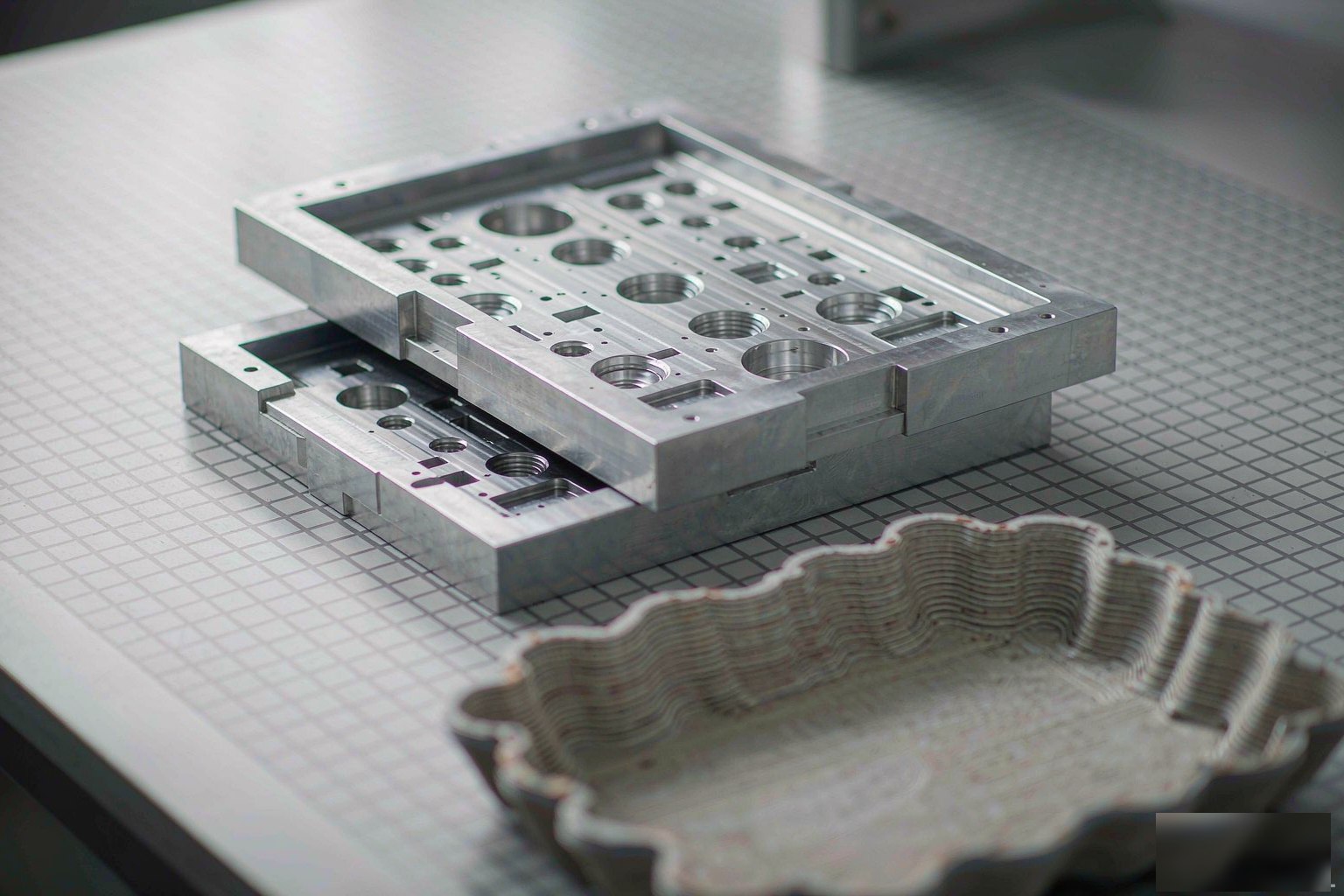
Tooling Essentials
Corner radii
≥ 5 mm sharply reduces stretch rupture and wrinkles.
Draft angles
≥ 5° aids demolding and film flow.
Vent network
Uniform venting avoids local non-conformance.
Surface finish
Conformance-face finish sets the visual grade of the lamination.
Lamination Tooling Reference
Lamination requirements should be reviewed together with forming-tool design at the design stage.
| Corner radii | Recommended R ≥ 5 mm; increase for deep-draw / high-stretch areas |
|---|---|
| Draft angles | Recommended ≥ 5°; adjust per tray structure and demolding requirements |
| Tool venting | Air must evacuate rapidly during lamination; groove width/depth and vent-hole count & layout validated per product and vacuum system |
| Vent hole size | 2.0–2.5 mm (bagasse pulp); wood pulp breathes well — hole size and count are set case by case |
| Forming / conformance surface | Flat and defect-free — no burrs, sharp edges or visible machining marks; roughness set by film material and appearance requirements |
| Tool material | Aluminum / cast aluminum etc., chosen per structure, temperature control and machining requirements |
| Review gate | DFM + lamination-process joint review before tool cut |
Tooling FAQ
Can existing tools run lamination directly?
Mostly yes, but tools with tight radii and shallow draft will see lower lamination yield.
How early should tooling review happen?
Complete the DFM review before cutting; write lamination requirements into the tool spec.
Is retrofitting expensive?
Venting and surface work is moderate; structural radius changes approach a new tool.
Need an Assessment for Your Application?
Share your tray geometry, application and performance requirements — a DNW engineer will help evaluate film structure and process parameters.
Discuss Your Project