
Can CPET Film Be Laminated to Molded Fiber Packaging?
Yes. CPET (crystallized PET) film withstands oven temperatures, making it the mainstream lamination solution for oven-ready and heatable molded fiber trays.
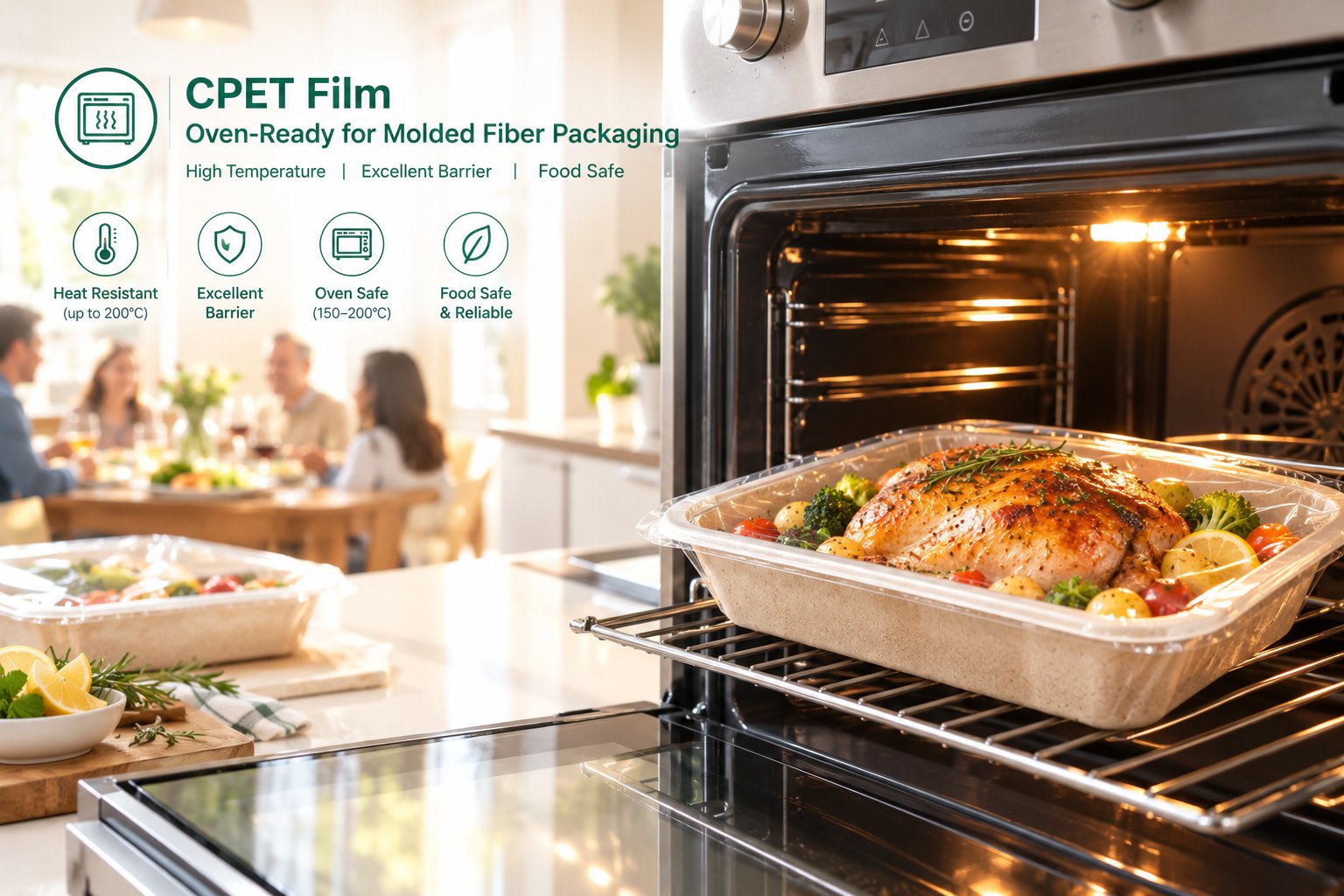
Why Choose CPET-Laminated Fiber Trays
High-Temperature
Withstands oven heating — ideal for ready meal and baking applications
Wide Temperature Window
Usable from frozen to oven (-40 to 220 °C); compatible with chilled, microwave and oven use
Lamination Performance
Softens evenly for good conformity; dimensionally stable after forming
Food Contact Compliance
Supported by EU food contact and FDA documentation (per latest test reports)
Typical Specifications
Indicative values — refer to official TDS
| Film Type | CPET film |
|---|---|
| Thickness Range | 0.04 – 0.10 mm (customizable per application) |
| Compatible Width | 810 – 1080 mm |
| Density | 1.3 g/cm³ |
| Lamination Temperature | Up to approx. 220°C |
| Oven Resistance (after lamination) | 180 – 220°C |
| Barrier Performance | Water / oil / alcohol resistant — excellent |
| Sealing Film | PET sealing film (easy-peel optional) |
| Appearance | Misty translucent |
| Typical Applications | Ready meals · Airline catering · Oven-ready foods |
FAQ
What is CPET film?
CPET is crystallized PET film. Crystallization greatly improves temperature resistance, enabling oven-ready applications — the mainstream choice for heat-resistant lamination.
CPET vs regular PET?
Regular PET offers good clarity but limited heat resistance; CPET's crystalline structure withstands heating and baking, though with typically lower transparency.
Is CPET right for my tray?
If your application involves heating, baking or a wide temperature range (freezer to oven), CPET is usually the best fit. Try the film selection tool on the homepage for a first assessment.
Need a CPET Lamination Assessment?
Share your tray geometry and heating conditions — a DNW engineer will help evaluate film structure and process parameters.
Discuss Your Project