
Why Is PBAT Film Ideal as the Heat-Seal Layer on Compostable Fiber Trays?
PBAT is milky-white and opaque, industrially compostable (EN 13432), laminated at ~120 °C and withstands 100–120 °C after lamination — used as the sealant and bonding layer for compostable fiber tray lamination structures.
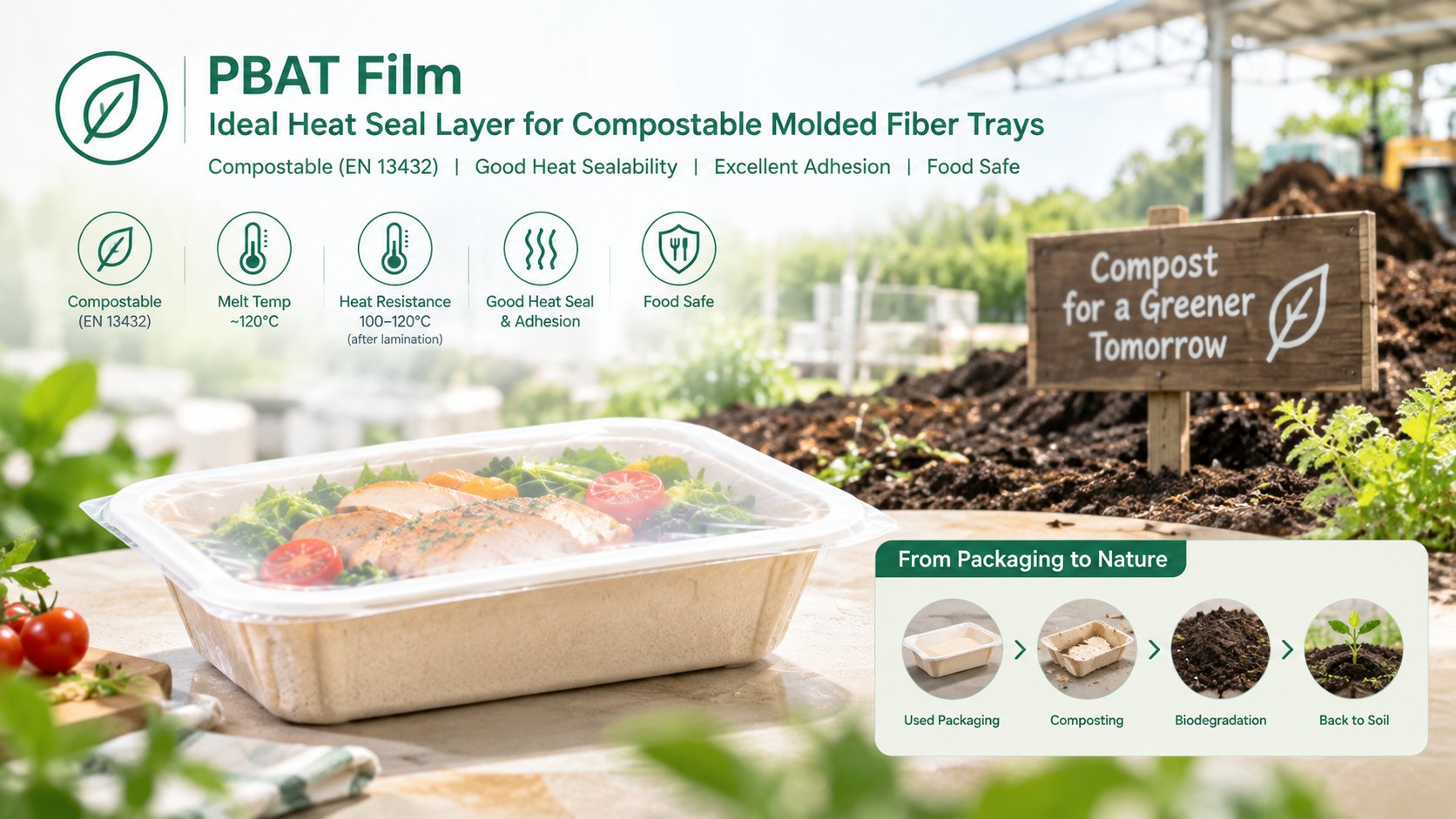
Key Characteristics of PBAT Film
Industrially compostable
EN 13432 industrial composting certified — the whole laminated pack can enter industrial composting.
Milky-white appearance
Opaque milky-white lamination — masks the tray base color while showcasing the food.
Low lamination temperature
Lamination at ~120 °C, withstands 100–120 °C after lamination.
Stock rotation note
Functional performance weakens after ~6 months in storage — order to demand and rotate FIFO.
Typical PBAT Film Parameters
Data from the DNW film information sheet (2026); resistance values vary by supplier and test conditions — verify by testing.
| Film type | PBAT film (milky-white) |
|---|---|
| Thickness range | 0.04 – 0.10 mm |
| Width | 810 – 1080 mm |
| Density | 1.3 g/cm³ |
| Lamination temperature | ~120 °C |
| Post-lamination resistance (oven) | 100 – 120 °C |
| Barrier performance | Water / Oil / Alcohol — all "So so" |
| Sealing film | Adhesive sealing film |
| Appearance | Milky white, opaque |
| Degradable / Compostable | Degradable · Industrially compostable (EN 13432) |
| MOQ | Milky-white 1000 kg · Colored 3000 kg |
| Typical applications | Compostable trays · Single-use food packaging |
PBAT Lamination FAQ
Is PBAT alone moisture- and oil-proof enough?
Only moderate. The information sheet rates all three barriers as "So so" — for higher requirements consider CPET or a laminate structure.
Does PBAT have a compostability certificate?
Yes — PBAT carries the EN 13432 industrial composting certificate.
How long can PBAT film be stored?
Performance gradually weakens after ~6 months; FIFO stock rotation is recommended.
Need an Assessment for Your Application?
Share your tray geometry, application and performance requirements — a DNW engineer will help evaluate film structure and process parameters.
Discuss Your Project