
How Much Does Lamination Improve the Mechanical Strength of Fiber Trays?
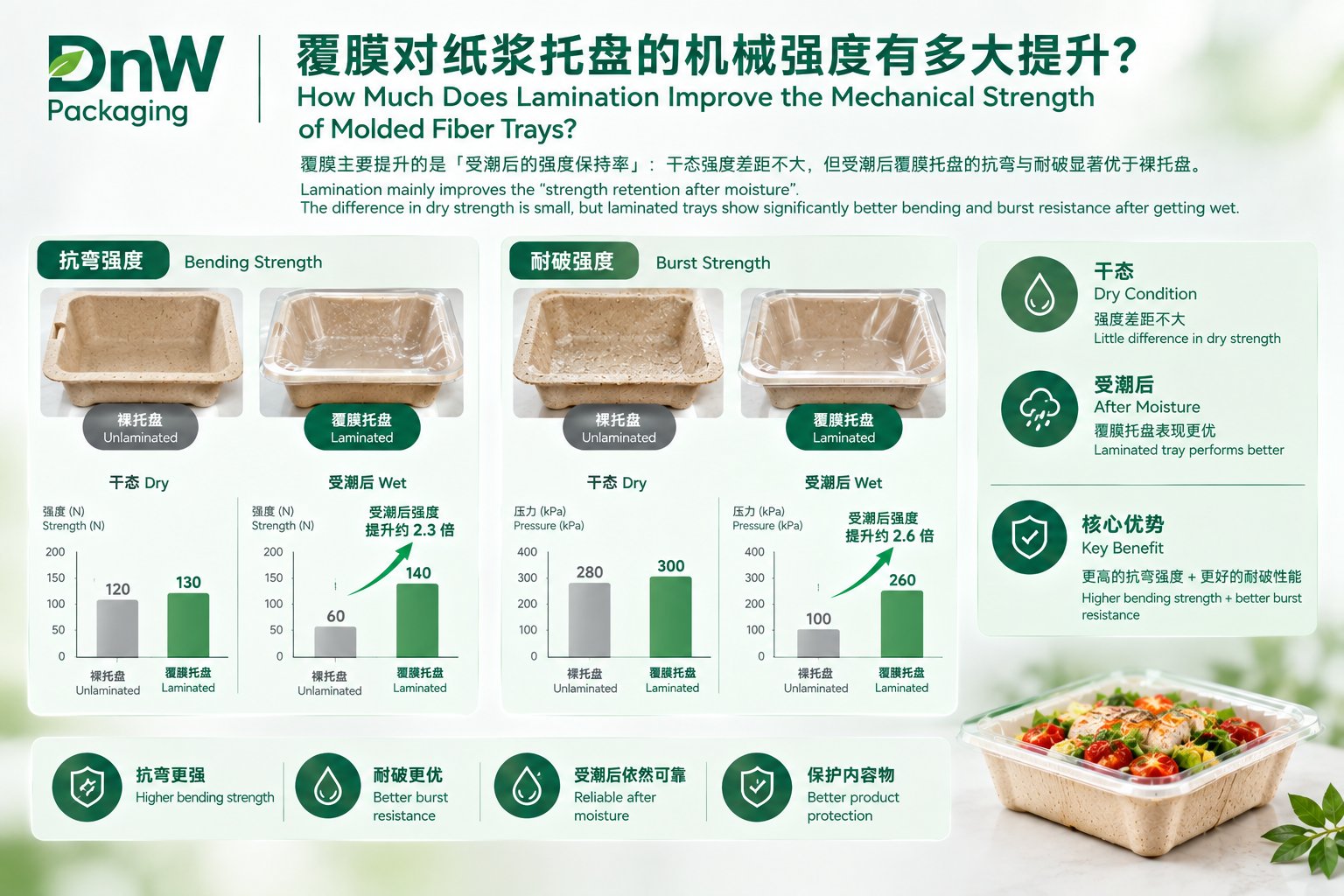
Lamination's main gain is 'wet-strength retention': in dry state the difference is small, but humidified laminated trays clearly outperform bare fiber in bending and burst.
Mechanical Essentials
Dry-state gap is limited
Lamination does not significantly raise dry stiffness.
Wet-state gain is huge
Strength retention under humidity is lamination's core value.
Stacking: compress
Run whole-tray compression per stack layers and T/RH.
Transport: vibrate
Simulate distribution per ISTA series.
Mechanical Test Matrix
Choose tests per actual service conditions.
| Bending | Three-point bend (ISO 2493 analogy) |
|---|---|
| Burst | GB/T 1539 / ISO 2759 |
| Whole-tray compression | Measured per stacking condition |
| Transport simulation | ISTA 1A/2A/3A |
| Wet-strength retention | Retest after high-humidity conditioning |
| Acceptance | Dual criteria: dry + wet |
Mechanical FAQ
Can lamination raise load capacity?
Only marginally in dry state; the real gain is wet-strength retention, which drives cold-chain reliability.
How to set acceptance criteria?
Set separate dry and wet limits, with wet criteria based on the worst distribution environment.
Can lighter-weight trays be used with lamination?
Yes — with moisture protection, some scenarios cut basis weight 10–20%; validate by testing.
Need an Assessment for Your Application?
Share your tray geometry, application and performance requirements — a DNW engineer will help evaluate film structure and process parameters.
Discuss Your Project